
Beyond the Hunt: Being an Adaptive Outdoorsman
Written by: Terry Colley, Fall Obsession Field Staff
Being an outdoorsman has never been just about harvesting an animal or filling a tag. Sure, there’s an undeniable excitement that comes with a successful hunt. The adrenaline, anticipation, and satisfaction of knowing your preparation and patience have finally paid off. But for me, being an outdoorsman means something much deeper.
It’s about tradition, family, and the memories made along the way. It’s those peaceful mornings when the woods come alive, watching wildlife through the lens of a camera, or simply enjoying the silence of nature. It’s passing down a love and respect for the outdoors and appreciating opportunities that so many take for granted.
As an amputee, however, experiencing those moments sometimes comes with challenges most hunters never have to consider.
The Outdoors Doesn’t Come With Accommodations
For many hunters, heading into the woods is relatively straightforward. Gather your gear, make your way to your hunting spot, and settle in. For an adaptive outdoorsman, even a simple hunting trip can require additional planning, preparation, and determination.
Uneven terrain, muddy trails, steep hillsides, and fallen trees can turn an ordinary walk into a physically demanding challenge. What might be a minor inconvenience to another hunter can completely change how I approach a hunt. And sometimes the mental challenges are just as demanding as the physical ones.
There are days when my body doesn’t cooperate, when the effort required to reach a hunting location seems greater than the reward. But I’ve learned that adapting isn’t about accepting limitations. It’s about finding ways around them. The hills aren’t going to get flatter, the mud isn’t going to disappear, and the deer certainly aren’t going to make things easier because I’m an amputee. Sometimes you just have to find another way.
A Hunt I’ll Never Forget
One of my most memorable hunts wasn’t about harvesting the biggest buck or filling a tag I had been chasing all season. It was an encounter with a doe that, in a strange way, I could relate to.
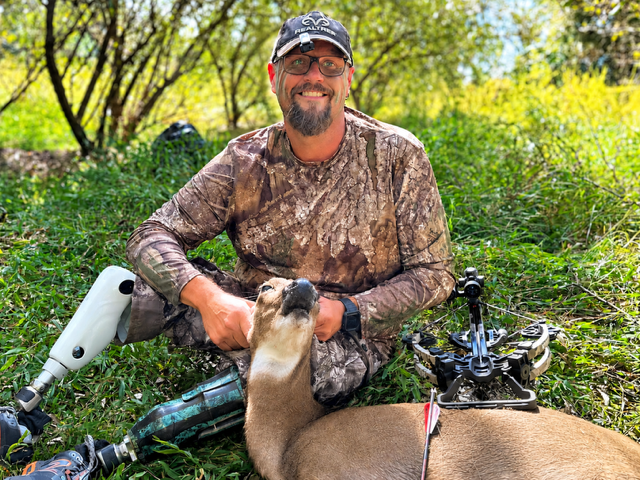
I had spent the day sitting in my hunting blind and was preparing to leave when I noticed a doe bedded down behind me. As I watched her, I realized something wasn’t right. She was missing the lower portion of one of her back legs. As an amputee myself, seeing an animal navigating life with a missing limb struck a chord with me.
She had obviously survived whatever caused her injury, but watching her struggle made me think about the reality of living in the wild. Predators don’t offer second chances, and I couldn’t help but think about how vulnerable she might be to coyotes. I made the decision to pursue her, knowing that a clean, ethical harvest was a better outcome than potentially becoming an easy meal for predators. What followed became one of the most memorable spot-and-stalk hunts I’ve experienced.
Armed with my bow, I carefully worked my way through the terrain, trying to close the distance without being detected. It became a cat-and-mouse game, with every movement requiring patience, timing, and careful consideration. Eventually, I was able to get within 40 yards.
I took my time, settled my sights, and released the arrow. The shot placement was exactly where I wanted it. She ran approximately 50 yards before going down. I was able to follow her trail, recover her, and complete the process.
That hunt has stayed with me, not because of the size of the animal or the difficulty of the shot, but because of everything surrounding it. Two living creatures navigating the outdoors with physical limitations, each adapting in our own way. It reminded me that the outdoors isn’t always easy or forgiving, but it also reinforced why I have so much respect for the wildlife I pursue.
More Than Filling a Tag
Don’t get me wrong. I love the excitement of a successful hunt. There’s nothing quite like seeing your preparation, patience, and hard work come together. But some of my favorite days outdoors have ended without a single shot being taken. Watching a young deer wander through the timber, capturing wildlife on camera, or sitting quietly as the sun rises over a frost-covered field can be just as rewarding.
Hunting is also about the traditions we share with family and friends. The stories told, lessons learned, and memories passed from one generation to another. Those experiences are what keep our outdoor heritage alive. As an outdoor content creator, I try to capture more than the harvest. I want people to experience the adventure, the challenges, and those small moments that make spending time outdoors so special.
Because sometimes the best thing you bring home isn’t an animal. It’s a memory.
The Reward Is in the Journey
Something people don’t always see in photos and videos of adaptive hunters is the effort that happens behind the scenes. They see the successful hunt, but not necessarily the physical exhaustion, the obstacles along the way, or the determination it took just to reach that location. And the hunt doesn’t always end when the arrow is released or the trigger is pulled. There’s still tracking, recovering the animal, carrying equipment, and making your way back out of the woods.
For an adaptive outdoorsman, those challenges can make an already demanding experience even more difficult. But overcoming them often makes the experience that much more rewarding. I’ve never wanted being an amputee to define what I’m capable of doing outdoors. It’s part of who I am, and it affects how I approach certain situations, but it doesn’t change my passion for hunting, fishing, wildlife, or the land.
I don’t want to be recognized simply as someone who hunts despite being an amputee. I want to be recognized as an outdoorsman who has learned to adapt. Because being an outdoorsman isn’t defined by how far you can walk, how steep a hill you can climb, or how easily you can reach your favorite hunting spot. It’s defined by your respect for wildlife, appreciation for the land, the traditions you carry forward, and the determination to keep doing what you love.
At the end of the day, the greatest reward isn’t always the tag you fill. Sometimes it’s knowing what you had to overcome just to be part of the hunt. And for me, that’s what being an adaptive outdoorsman is all about.
About the Author
The Outdoor Amputee is an adaptive outdoorsman and content creator sharing his passion for hunting, fishing, wildlife, and outdoor adventures. Through his experiences, he encourages others to overcome obstacles, embrace the outdoors, and never let physical limitations define their adventures.
Website: https://theoutdooramputee.com