
Are We Misunderstanding Summer Bachelor Groups?
Written By: Ryan Reading, Fall Obsession Pro Staff
Have you noticed that more mature velvet bucks seem to be spending time with does and fawns instead of traditional bachelor groups? Over the last five or six summers, that is exactly what has caught my attention.
For decades, deer hunters have accepted one common belief about summer whitetail behavior. Once spring gives way to summer, mature bucks leave the doe family groups and form bachelor groups while their antlers continue growing in velvet. In many areas, that still happens, and countless trail camera photos prove it every year. However, after reviewing thousands of trail camera photos, I have begun noticing something that seems to challenge that long held belief.
This observation is not based on one property or a handful of trail camera photos. I run approximately 33 Tactacam trail cameras across Western New York, and the images come from a wide variety of habitats, including agricultural country, state land, and private properties. Those cameras have captured thousands of images over the years, and one trend continues to stand out. I keep seeing mature velvet bucks spending much of their summer around does and fawns instead of traveling with other bucks. These are not yearling or two year old deer. Many are mature bucks with the kind of antler potential every hunter hopes will still be around when fall arrives.
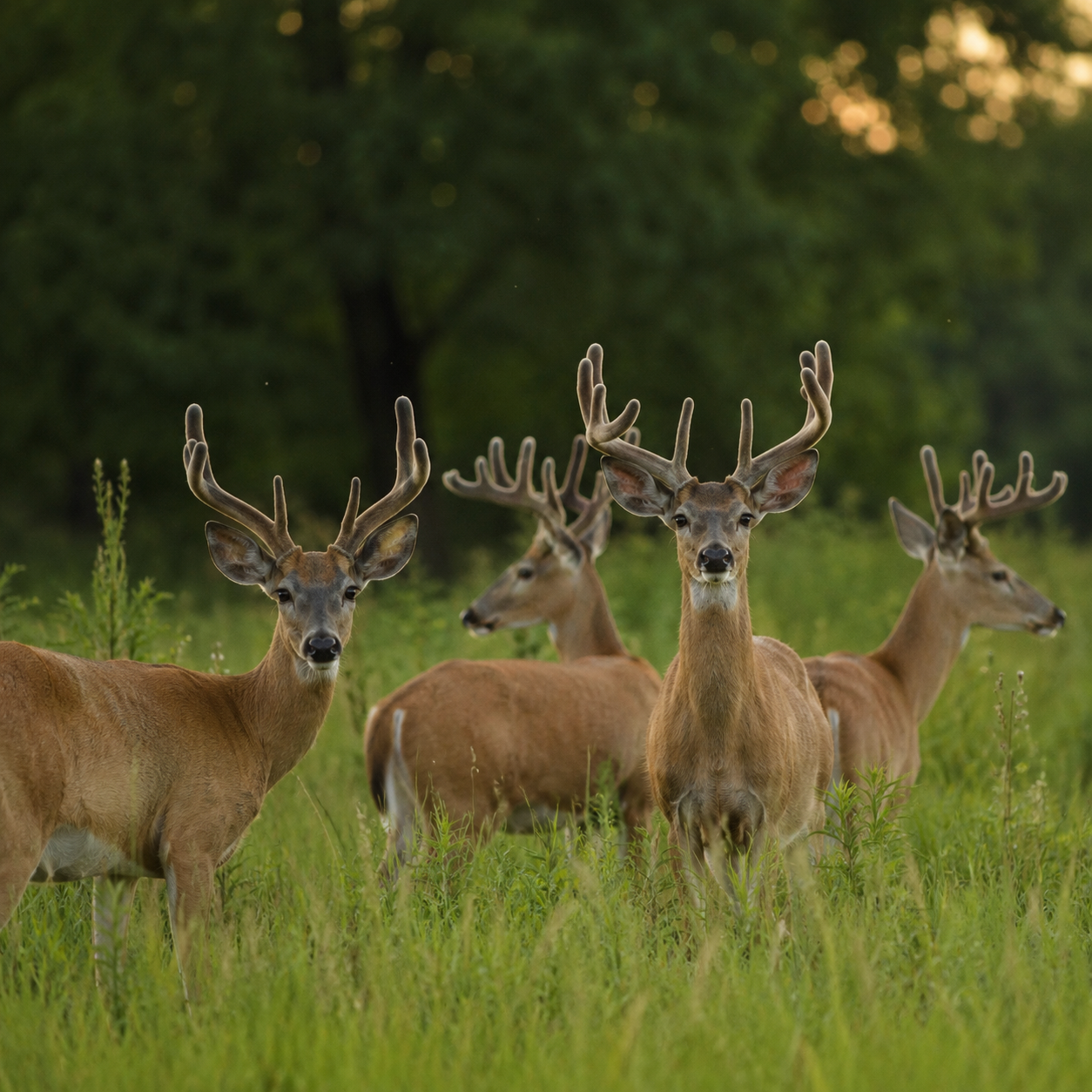
The more I saw it, the more one question kept coming to mind - “Why?”
As hunters, we often accept that bachelor groups are simply what bucks do during the summer. Low testosterone levels reduce aggression, food is plentiful, and bucks can peacefully share feeding areas until late summer when velvet is shed. While that remains true, I believe there may be another piece of the puzzle.
In my opinion, the largest and most dominant bucks often claim the very best summer habitat. They establish themselves around the highest quality food sources, the safest bedding cover, dependable water, and the locations where they feel most secure. Whether it is because of age, experience, or simple dominance, these mature deer seem to take control of the best real estate long before hunting season ever begins.
If that is true, where does it leave the next tier of mature bucks? My hypothesis is that these bucks simply adapt.
Rather than competing for the same prime habitat, they settle into the next best areas available. Those locations often overlap with doe family groups. As long as they have quality food, security, and water, there may be little reason for them to search for bachelor groups elsewhere. Instead, they spend much of the summer sharing the same habitat as does and fawns.
Another observation supports this possibility. Even bucks that are believed to be related often separate as they mature. Once they reach three or four years of age, many establish their own home ranges instead of remaining with siblings or family members. If mature bucks naturally spread out with age, it makes sense that dominant individuals could occupy the very best habitat while other mature bucks establish themselves wherever suitable habitat remains.
I have watched mature velvet bucks feeding calmly alongside doe family groups for weeks at a time. They show no signs of discomfort, and neither do the does or fawns. These do not appear to be chance encounters. They appear to be part of their normal summer routine.
There are certainly other explanations that deserve consideration.
High quality food sources naturally attract every deer in the area. Agricultural fields, natural browse, food plots, water, and secure bedding cover can all create locations where bucks and doe family groups overlap throughout the summer.
Population structure may also play an important role. In some regions there simply may not be enough mature bucks living close together to create the classic bachelor groups many hunters expect. At the same time, I have also noticed that some mature bucks seem perfectly content spending much of the summer alone. Several of the largest bucks I have photographed consistently appear by themselves, even when other mature bucks are known to be in the area.
That observation raises another interesting question. If a mature buck lives in an area with few other mature bucks, could he simply become accustomed to sharing portions of his summer range with familiar doe family groups? Rather than spending the summer entirely alone, perhaps some bucks tolerate or even prefer remaining near does and fawns simply because those deer occupy the same secure habitat day after day. It may have little to do with breeding and more to do with familiarity, security, or simply sharing the best available resources. While this is only a hypothesis, it is another possibility worth considering.
It is also possible that bachelor groups are more fluid than we once believed. Bucks may feed together one evening, separate for several days, and regroup later. Thanks to today's trail camera technology, hunters are witnessing far more of a deer's daily life than ever before. Some of what appears to be new behavior may simply be behavior we never had the opportunity to observe in the past.
This article is not intended to prove a new theory. It is simply meant to encourage hunters to look more closely at what their cameras are showing them.
My hypothesis is that dominant mature bucks often secure the highest quality summer habitat while other mature bucks adapt by occupying the next best locations, many of which are already shared by does and fawns. At the same time, some mature bucks appear to prefer spending much of the summer alone, while others may become comfortable sharing portions of their home range with familiar doe family groups. If those observations hold true, then perhaps there is no single rule that governs summer buck behavior. Mature whitetails may be far more adaptable and individualistic than many of us have believed.
One thing I have learned after years of studying trail camera photos is that mature bucks rarely follow every rule we give them. Every season they remind us there are exceptions to almost everything we think we know.
Perhaps bachelor groups are not disappearing. Perhaps we are finally paying close enough attention to realize that mature bucks have always been more adaptable than we gave them credit for.
This summer, I have a challenge for every hunter reading this. Do not just count antler points or estimate a buck's score. Study the company he keeps. Look at every trail camera photo and ask yourself who is standing beside that mature buck. Is he traveling with other bucks, spending his summer around does and fawns, or living almost entirely on his own? Follow those patterns for several weeks instead of drawing conclusions from a single picture.
If hunters across different regions begin paying attention to these behaviors, we may discover there is still much to learn about summer whitetails. I would love to hear what others are seeing on their own properties because some of the greatest discoveries in deer hunting begin with a simple question, an open mind, and thousands of trail camera photos.
Maybe the next breakthrough in understanding mature bucks will not come from a research paper or a textbook. Maybe it will come from hunters who slow down, study the patterns unfolding in front of their trail cameras, and are willing to question long held assumptions. Every season, the whitetail teaches us something new. We simply have to be willing to watch and learn.