
The Process of Elimination: Finding the Buck Others Cannot
Written by: Ryan Reading, Fall Obsession Pro Staff
Every year I receive messages from hunters who tell me they have a giant buck on their property but cannot seem to figure him out. They have trail camera pictures throughout the summer, they have found fresh rubs and scrapes, and maybe they have even watched him feeding in a field from a distance. Then opening day arrives and it is as if the buck simply disappeared. They spend the entire season chasing old pictures instead of hunting the deer that is standing in front of them.
When I look at a property, I do not immediately ask myself where that buck is traveling. Instead, I ask myself where he probably is not traveling. That may sound backwards, but after years of studying mature whitetails, I have found that the quickest way to locate an old buck is often by eliminating the places he has no reason to be. I call it the process of elimination, and it has helped me locate mature deer that many hunters believed had simply vanished.
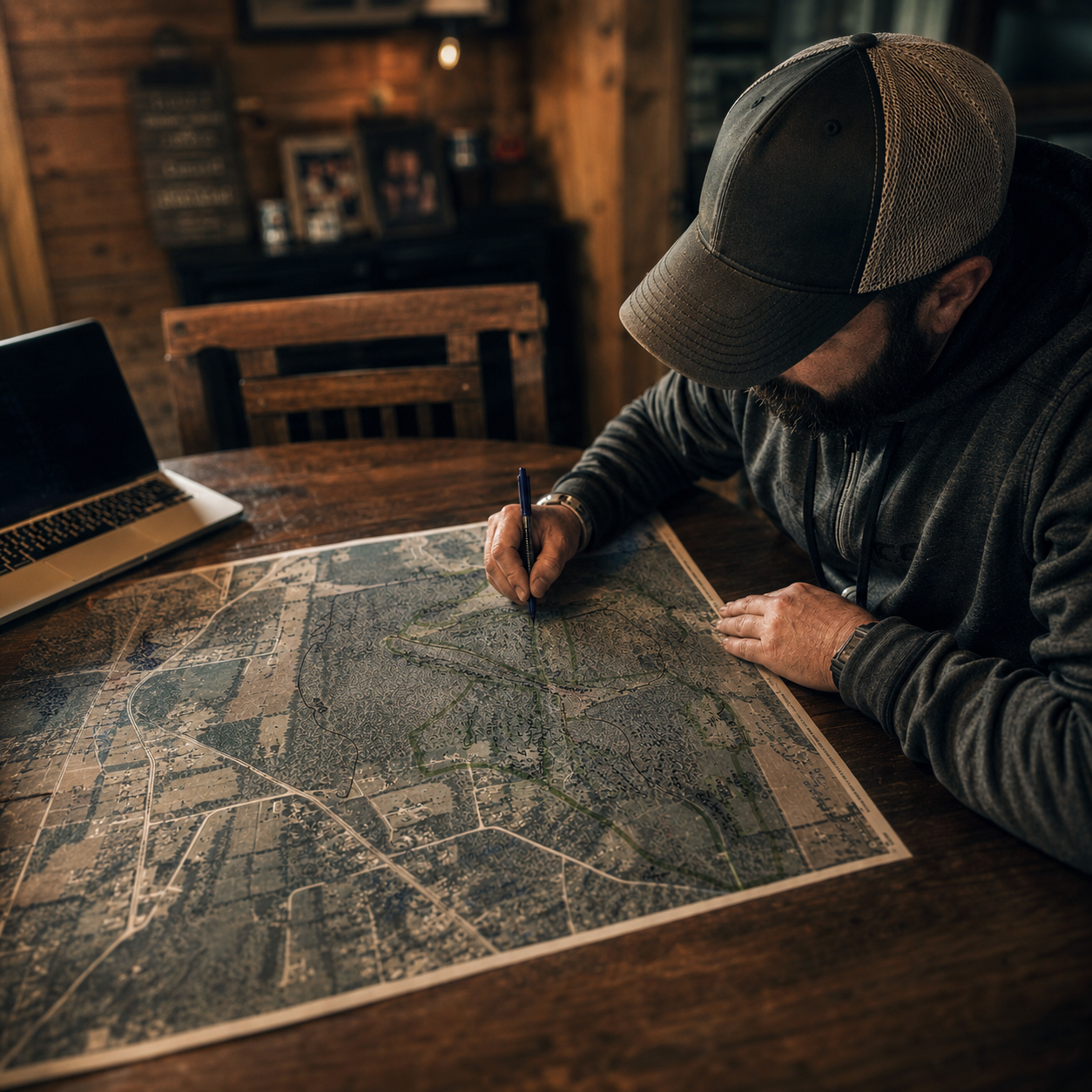
The first thing I do is begin marking everything I know on an aerial map. I mark every trail camera picture, every visual sighting, every fresh scrape, every significant rub line, every bedding area, and every destination food source. Those are the facts. Once those locations are identified, I begin eliminating the areas that simply do not fit the behavior of an experienced mature buck.
One mistake I see hunters make over and over is becoming fixated on the exact location where they photographed the buck. They immediately want to hang a stand near that camera because that is where he showed up. I actually begin eliminating that camera location because, more often than not, the buck was simply traveling through it. To me, a trail camera is just another point on the map. The real value is not where the picture was taken, but where that buck was coming from and where he was headed. My goal is to connect Point A to Point B. As more pictures begin to accumulate, those random points slowly become lines, and those lines often reveal travel corridors that no single trail camera could ever show on its own.
I start looking for tree stands, not just my own, but the neighboring properties as well. I want to know where hunters have traditionally set up, where they enter the woods, where they park, and which trails receive the most foot traffic. Old climbing sticks, forgotten screw in steps, worn access trails, ATV paths, and obvious funnels all become part of the investigation. Every one of those locations tells me where hunting pressure exists, and every one of them helps narrow the search.
Let's face it. A five or six year old mature buck did not survive by repeatedly walking within easy bow range of known hunting stands. He reached that age because he learned where danger exists. He understands where hunters like to sit, how they enter a property, and which routes expose him to unnecessary risk. Mature bucks become mature because they consistently make better decisions than the people hunting them.
This is where many hunters unknowingly make another mistake. They analyze mature bucks the same way they analyze every other deer on the property. Young bucks often travel the easiest route. They make mistakes. They expose themselves. Mature bucks are different. Their first priority is survival, and every decision they make is based on reducing risk. That is why I spend almost as much time studying hunters as I do deer. Every tree stand, every worn access trail, every old climbing stick, and every shortcut into the woods tells me something. Those clues are just as valuable as the deer sign itself because they help explain why an old buck chooses one route over another.
As more locations are crossed off the map, something interesting begins to happen. The property begins to shrink. Areas that once looked like endless possibilities are eliminated one by one until only a handful of logical travel routes remain. Those random trail camera pictures begin connecting together, and what once looked like an unpredictable buck suddenly starts following a pattern.
One trail camera picture rarely tells you much. Five pictures begin to establish a pattern. Twenty pictures collected over several weeks while paying attention to wind direction, weather conditions, food sources, and the time of day begin telling a story. I am not collecting pictures. I am collecting evidence. Eventually that evidence starts answering questions that I could never answer by looking at one photograph.
That is when I stop asking where he is going and begin asking why he chose that route. Is he avoiding the ridge because hunters always walk it? Is he slipping just below the military crest where he can travel without being silhouetted? Is he using thick cover to stay hidden from both sight and scent? Every answer removes another possibility until eventually the most likely route reveals itself.
Sometimes I ask myself a simple question. If every person in the woods was trying to kill me, how would I travel across this property? I certainly would not walk down the main trail or pass within twenty yards of every tree stand I knew existed. I would use terrain, cover, and the wind to stay hidden. I would choose the path that offered the least amount of risk. In many ways, that is exactly how an old buck survives.
I have always believed that finding a mature buck is less about discovering something nobody else knows and more about removing everything that does not make sense. Most hunters spend their time adding theories. I spend mine eliminating them. More often than not, the truth is sitting in the small section of the map that everyone else overlooked because they were too busy focusing on where they wanted the buck to be instead of where a mature buck would actually choose to travel.
The next time you find yourself staring at trail camera pictures wondering where that giant disappeared to, stop trying to predict every move he might make. Instead, begin asking yourself where he probably did not go. Eliminate the obvious stands. Eliminate the common access routes. Eliminate the areas that expose him to unnecessary danger. Then connect your trail camera pictures and ask yourself how that buck traveled from Point A to Point B. More often than not, that journey will teach you far more than the picture itself ever could.
Because the biggest bucks are not found by adding more guesses. They are found by eliminating the wrong ones until only the truth remains.